
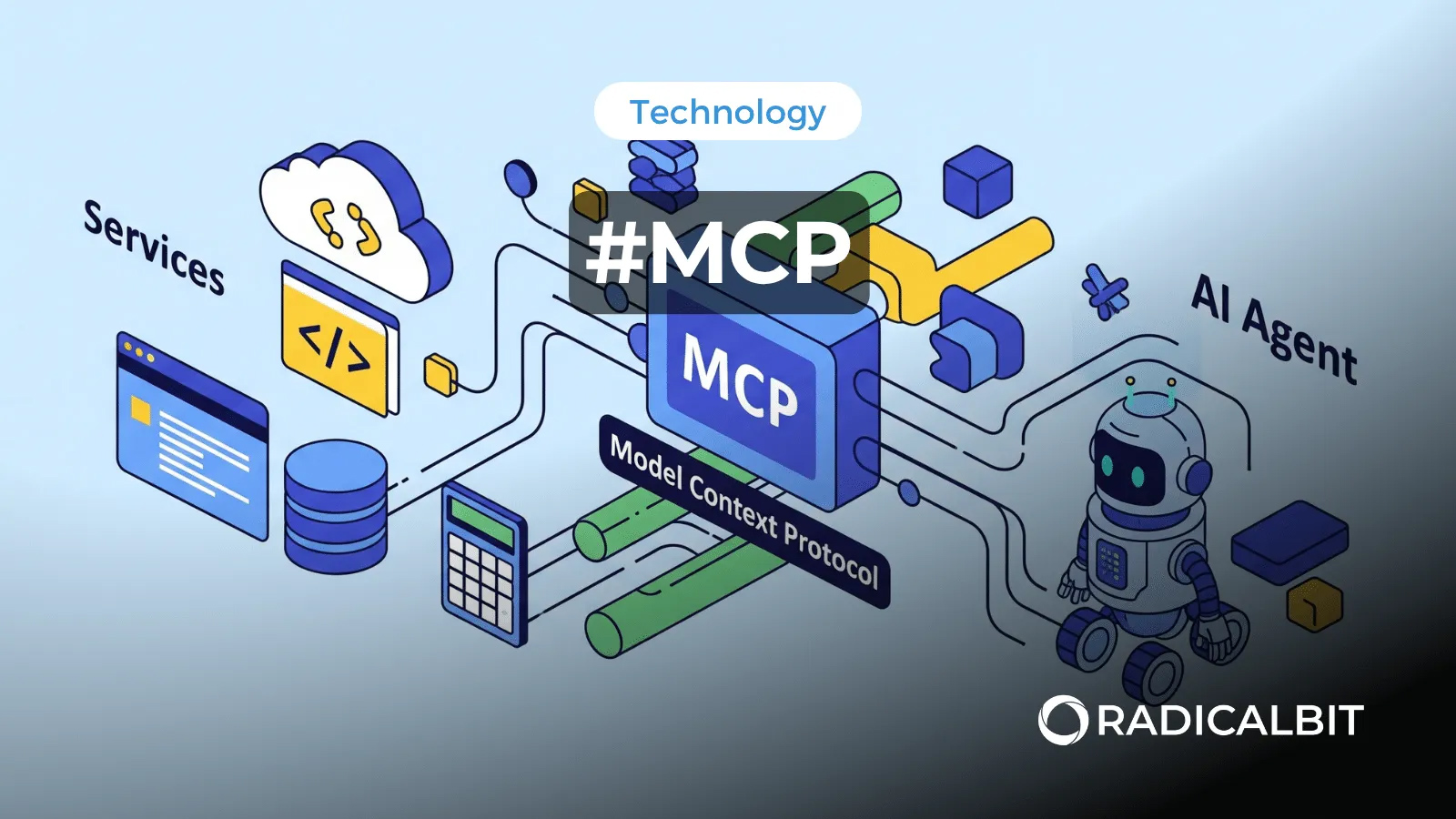
Since ChatGPT became publicly available at the end of 2022, Generative AI technologies have evolved in many different areas. For sure, one of the most important applications to have emerged is Agentic AI.
In a few words, an AI agent is a software program that uses artificial intelligence (AI) to perform tasks and interact with users. AI agents can learn, adapt, and make decisions independently.
An agent can use different tools to retrieve information or to perform actions. In fact, tools enable agents to perform tasks beyond language generation, such as retrieving structured or unstructured data and executing custom code.

As you can see, tools often require ad-hoc integration that must be implemented every time, without being reused between different applications. This leads to inefficiencies and operational bottlenecks. To address this critical limitation, the MCP technology has recently emerged as a new standardised protocol and promising solution.
What is the Model Context Protocol (MCP)?
The MCP is a standard designed by Anthropic and made publicly available in November 2024.
“The Model Context Protocol is an open standard that enables developers to build secure, two-way connections between their data sources and AI-powered tools. The architecture is straightforward: developers can either expose their data through MCP servers or build AI applications (MCP clients) that connect to these servers.”
As the specification states, MCP provides a standardized way for applications to:
- Share contextual information with language models
- Expose tools and capabilities to AI systems
- Build composable integrations and workflows

Why MCP and Why Should I Learn It?
Okay, let’s take a more in-depth look at the Model Context Protocol (MCP) and why it’s generating such a buzz within the AI community.
At its core, MCP is a transformative paradigm for anyone developing AI agents that need to engage with the real world. It transcends the limitations of mere text generation; it empowers AI to take action, retrieve information, and make decisions based on real-time data. This shift marks a significant departure from traditional AI models that were largely confined to the realm of language processing.
Historically, integrating AI models with external tools and data sources has been a cumbersome and time-consuming process, often requiring custom code and intricate workflows. MCP addresses this challenge by providing a standardized framework for communication between AI models and the outside world. This standardization streamlines the integration process and opens up a world of possibilities for AI development.
Imagine MCP as a universal language that AI models can comprehend. Instead of having to craft bespoke integrations for each specific task or data source, developers can now leverage MCP to seamlessly connect their AI agents with a vast array of tools and services. This not only saves valuable time and effort but also fosters interoperability and reusability, allowing developers to build upon existing work and accelerate the development process.
Key Advantages of MCP
Simplified Integration: MCP abstracts away the complexities of connecting AI models with external systems, making it easier for developers to build sophisticated AI agents without getting bogged down in intricate integration details.
Enhanced Capabilities: By providing a standardized way to access real-time data and trigger actions, MCP empowers AI agents to perform a wider range of tasks and deliver more valuable insights. This enhanced functionality opens up new possibilities for AI applications across various domains.
Open Standard: MCP is not tied to any specific platform or vendor, which means developers can use it with their preferred tools and frameworks, promoting flexibility and innovation.
Reusability: MCP encourages the creation of reusable components and workflows, which can be shared and leveraged across different projects. This reusability fosters a collaborative ecosystem and accelerates the development of AI solutions.
Learning the Model Context Protocol (MCP) is essential for developing advanced AI agents capable of meaningful interaction with the real world. This skill will become increasingly valuable as AI evolves and its influence expands. Mastering MCP enables the creation of AI agents that are smarter, more capable, and more connected, allowing them to address complex challenges and provide significant value.
MCP: Technical Overview
MCP establishes a robust framework for communication and interaction between AI models and their surrounding context. This interaction is facilitated through two primary components: MCP servers and MCP clients.
MCP Servers: The Contextual Gateways
MCP servers function as the custodians of data and tools, serving as intermediaries that bridge the gap between raw data and the AI models that leverage them.
- Data Exposure and Structuring: MCP servers empower developers to present data in a structured and organized manner that is comprehensible to AI agents. This structured data facilitates seamless integration and efficient utilization by AI models.
- Tool Integration and Abstraction: A key feature of MCP servers is their ability to integrate a wide array of external tools and services. By providing a standardized interface, these servers abstract the complexities of individual tools, enabling AI agents to interact with them uniformly.
- Security and Access Control: MCP servers play a pivotal role in ensuring data security and integrity. They implement robust access control mechanisms, ensuring that data is accessed only by authorized AI agents and in accordance with predefined security policies.
MCP Clients: The Intelligent Agents
MCP clients are the AI applications that harness the capabilities of MCP servers. These clients adhere to the MCP standard to request information, initiate actions, and process responses.
- Contextual Information Retrieval: MCP clients can actively request and receive contextual information from MCP servers. This contextual data enriches the clients’ understanding of the task at hand, enabling them to make informed decisions and generate contextually relevant responses.
- Tool Utilization and Orchestration: By leveraging the standardized interface provided by MCP servers, clients can seamlessly utilize the exposed tools. This facilitates the orchestration of complex workflows, where AI agents can leverage multiple tools in tandem to achieve their objectives.
- Composability and Scalability: MCP clients can establish connections with multiple MCP servers simultaneously. This composability allows clients to combine diverse tools and data sources, creating intricate and scalable solutions that can adapt to evolving requirements.
Key Technical Underpinnings
- Standardized Communication and Interoperability: MCP defines a standardized communication protocol and data format that ensures seamless interoperability between clients and servers. This standardization promotes consistency and facilitates integration across different implementations.
- Bidirectional Communication and Feedback Loops: MCP supports bidirectional communication, enabling AI agents to both request and provide information. This bidirectional flow facilitates feedback loops, where AI agents can refine their understanding based on the responses received from MCP servers.
- Open Standard and Extensibility: MCP is an open standard, fostering collaboration and innovation within the AI community. Its open nature encourages developers to contribute to its evolution and extend its capabilities to address emerging challenges.
Beyond the core technical aspects, several additional considerations enhance the utility and adaptability of MCP. It can be tailored to the unique contextual needs of various AI models, guaranteeing that agents receive the most pertinent information for their operations. Furthermore, MCP facilitates real-time updates of contextual data, ensuring that AI agents have access to the newest information and insights, a crucial capability for applications functioning within dynamic and rapidly evolving settings. Lastly, MCP can support contextual reasoning and inference, enabling AI agents to utilize the available context to form conclusions and predictions, thereby improving the precision and significance of AI-generated results.
Wrap-up
The Model Context Protocol (MCP) presents a comprehensive and adaptable framework for integrating AI models with their surrounding context. By standardizing communication, promoting interoperability, and supporting bidirectional information flow, MCP empowers developers to create intelligent and context-aware AI applications. These applications can effectively leverage the wealth of data and tools available, leading to smarter, more capable, and more connected AI agents.
MCP addresses the challenge of integrating AI models with external tools and data by providing a standardized framework for communication. This standardization streamlines the integration process, saves valuable time and effort, and opens up a world of possibilities for AI development. Key advantages include simplified integration, enhanced capabilities, open standard nature, and reusability of components.
As AI continues to evolve, mastering MCP will become increasingly essential for developing advanced AI agents. By embracing the MCP revolution, developers can stay ahead of the curve and build AI agents that can truly make a difference, tackling complex challenges and delivering tangible value. The future of AI with MCP holds the potential for a surge in AI agents capable of performing a diverse range of tasks, transforming industries, enhancing productivity, and fundamentally changing the way we live and work.

