The AI Sprawl is the uncontrolled proliferation of AI tools and models within a company. It occurs when teams adopt fragmented solutions without a centralized strategy, leading to operational redundancies, hard-to-track costs, and compliance risks related to data persistence.
The democratization of AI has shifted the innovation bottleneck from mere engineering capability to organizational governance. The core question for every engineering lead today is: do we have a scalable governance framework ready to support the AI solutions we have already deployed?
With the spread of LLMs and low-code frameworks, many companies find themselves grappling with a fragmented ecosystem: disconnected models, experimental prototypes, and shadow integrations operating outside of any IT oversight.
This fragmentation is more than an operational nuisance: it is a structural shift in the company’s technical and legal risk profile.
How Rapid Prototyping Fuels Duplication
The barrier to entry for AI development has effectively collapsed. What once required months of work from a data science team can now (in some cases) be prototyped by a developer with just a few API calls: a pre-trained model and you’re good to go.
This speed is real and must be preserved; however, it masks a problem that is growing in silence: duplication.
When every unit can build its own intelligent microservice, the company ends up paying multiple times for the same capabilities. One team uses an LLM for document summarization; another department builds a nearly identical tool with a different provider, separate credentials, its own billing cycle, and a security configuration that no IT team has ever seen. Multiplied by several departments, the problem is no longer manageable through simple conversation. This duplication does more than just inflate cloud costs: it effectively dilutes the company’s technical focus. Every rapid prototype carries with it long-term maintenance, updates, and monitoring requirements.
In a context of AI Sprawl, engineering overhead stops being value-driven and turns into the management of a chaotic library of overlapping tools.
Without clear architectural standards and agile governance processes, it is impossible to leverage economies of scale or enforce a consistent strategy; a centralized entry point is the essential infrastructure to operationalize these guidelines.
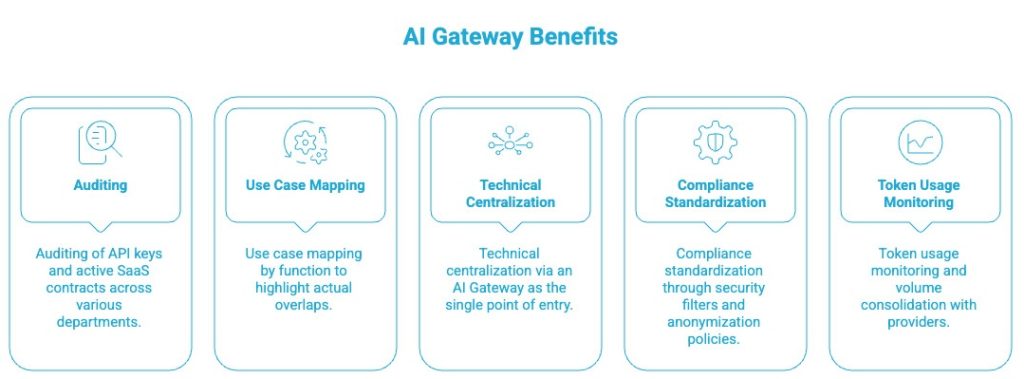
To manage this scenario, companies working on this issue tend to converge on a similar framework:
- Auditing of API keys and active SaaS contracts across various departments.
- Use case mapping by function (text generation, data analysis, etc.) to highlight actual overlaps.
- Technical centralization via an AI Gateway as the single point of entry for all model calls.
- Compliance standardization through security filters and anonymization policies configured at the gateway level rather than within individual applications.
- Token usage monitoring and volume consolidation with providers to transition from retail billing to enterprise rates.
Data Persistence and the Shadow of Compliance
The risks of AI Sprawl extend far beyond operational inefficiency, entering the territory of data integrity and legal liability.
One aspect that is often overlooked is the persistence of derived data. When a team feeds proprietary data into a model, whether for fine-tuning, RAG or standard processing, that data does not vanish once the original source is deleted. The insights, embeddings, and derived weights persist within the AI ecosystem.
This creates a concrete problem when GDPR regulations come into play. If a customer exercises their right to be forgotten, deleting the original records is no longer sufficient. If that data has been ingested into an untracked AI tool, it remains alive in the form of outputs, entries in a vector database, or patterns in a fine-tuned model. Demonstrating compliance in these cases becomes an exercise in technical archaeology, not governance.
The Friction Between Speed and Governance
In software development, team autonomy is fundamental. But in the context of AI, high speed without a shared framework leads directly to chaos. The more independent teams are in managing their own API keys, the more the company’s AI attack surface expands to a point where it can no longer be defended or optimized.
This friction often leads to a false choice: either slowing down innovation with rigid approval processes or letting every team do whatever they want. Traditional IT governance fails because it isn’t fast enough to keep pace. The problem is not governance itself, but the fact that it is being applied in the wrong place.The solution is not to add constraints to the development process; it is to evolve the infrastructure through which experimentation occurs and, simultaneously, to overhaul the AI adoption processes to make them more agile. It is about giving teams the autonomy they seek while maintaining the visibility and control the company requires to prevent sprawl at its source.
Structural Visibility: Regaining Control of the AI Stack
To mitigate the risks of AI Sprawl, the point of intervention must be the flow of AI interactions in conjunction with a robust use case mapping process, rather than just the teams generating them. Governance must therefore be integrated into the communication layer between the application and the model.
A centralized AI Gateway does exactly this: it provides a birds-eye view of every request, every token spent, and every piece of data shared. This visibility enables the mandatory tracking of use cases, a key prerequisite for risk classification and EU AI Act compliance and makes duplications immediately identifiable. If three teams are querying the same provider for the same task, the Gateway reveals it and enables consolidation.There is also a less obvious operational and legal benefit: the so-called kill switch. If a model provider changes their terms of service or a vulnerability is discovered, a centralized layer supported by clear internal processes allows for an immediate pivot without having to identify and patch dozens of scattered microservices. In a fragmented environment without mapped use cases, that same operation could take weeks.
Governance vs. Fragmentation
To understand the real impact of these dynamics, it is useful to compare the risks arising from a fragmented approach with the structural advantages offered by the integration of a centralized AI Gateway:
| Feature | Decentralized Approach (Silos) | Centralized Approach (AI Gateway) |
| Cost Visibility | Fragmented/Unknown | Real-time Monitoring |
| Data Privacy | Shadow AI Risk | Centralized PII Filters |
| Team Agility | High (but chaotic) | High (with Guardrails) |
| Compliance | Reactive/Complex | Proactive/Simplified |
The Role of the Radicalbit AI Gateway
Radicalbit addresses this problem at the infrastructural level. The AI Gateway, in fact, acts as an orchestration layer between development teams and the AI models in use, eliminating the need for each team to manage separate integrations and providing a standardized, high-performance interface.
This architecture transforms AI from a collection of isolated experiments into a governed corporate asset, acting as a single secure point of entry that decouples the used LLM model from the complexity of providers.
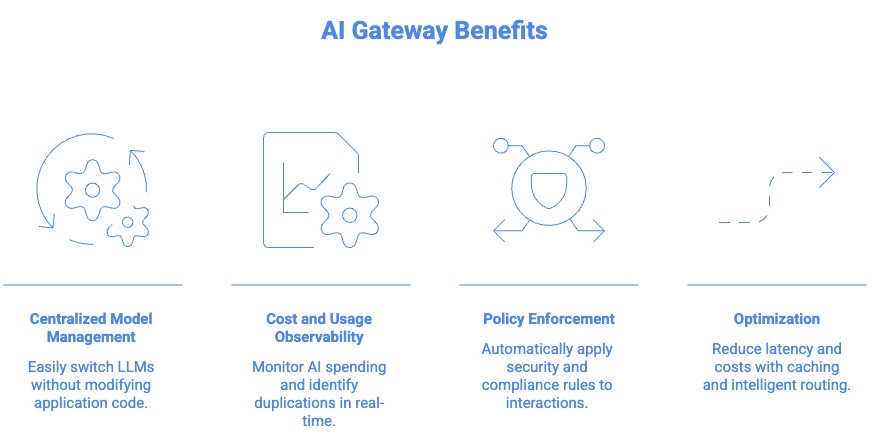
In practice, adopting an AI Gateway translates into:
- Centralized model management: switching LLMs without touching a single line of application code.
- Cost and usage observability: real-time monitoring of AI spending across the entire company, with visibility into duplications.
- Policy enforcement: security and compliance rules automatically applied to every interaction, ensuring sensitive data never leaves the perimeter without explicit authorization.
- Optimization: caching and intelligent routing to reduce latency and costs on repetitive queries.
From Chaos to AI Strategy
The AI Sprawl is the natural result of a powerful technology meeting a decentralized structure, and it tends to emerge in almost every company that has adopted AI at a rapid pace.
The companies that will be able to innovate are those capable of governing AI at scale, knowing where it runs, how much it costs, who can access it, and what happens to the data that fuels it.
A centralized AI Gateway is the most direct way to make that transition: teams maintain operational speed, while the company gains the visibility it needs. Discover how the Radicalbit AI Gateway can centralize governance and accelerate innovation through unified model management, cost monitoring, and the securing of corporate data flows.
Frequently Asked Questions: Governing AI Sprawl with an AI Gateway
The AI Gateway acts as a unified control center. Instead of having dozens of direct connections between applications and models, each with its own credentials, policies, and costs, all interactions pass through the gateway. The result is immediate visibility and the end of Shadow AI.
No. Intelligent caching accelerates responses for repetitive queries, while also reducing the load on providers. The perceived slowdown, which often frightens teams, does not materialize in production.
The AI Gateway anonymizes sensitive data (PII) before it leaves the corporate perimeter. It does not require modifying individual applications: the policy is enforced at the infrastructure level.
Quite the opposite: it abstracts the provider, so teams can switch or test new models without rewriting code. The freedom to experiment increases, rather than decreases.
Integration is incremental: the AI Gateway exposes standardized APIs that overlay the existing infrastructure. It does not require shutting down what is already working, on the contrary, it requires routing it.
Key Takeaways
- The AI Sprawl generates invisible technical debt: redundancies accumulate silently until they become a governance problem that is impossible to ignore.
- Data persistence in ungoverned models is a genuine legal risk: the GDPR right to be forgotten is not exercised by simply deleting a record if that data has been ingested into a shadow tool.
- The conflict between speed and control can be resolved at the infrastructural level: it is not a choice between agility and governance; rather, it is about moving governance to the right place.
- Secure scalability requires structural visibility: Radicalbit provides the tools to transition from a fragmented AI ecosystem to a governed one, without halting innovation.