

LLM Usage Control refers to the set of architectural, financial, and operational practices that enable enterprises to monitor, limit, and optimize how Large Language Models are consumed. It encompasses token governance, semantic caching, rate limiting, and real-time observability, all aimed at transforming AI spend from an unpredictable variable into a strategic, manageable asset.
The rapid integration of Large Language Models (LLMs) into the enterprise fabric has shifted the conversation from what is possible to what is sustainable.
While early LLMOps strategies focused on immediate cost containment, the current fiscal climate demands a transition toward enterprise-grade architectural discipline, FinOps alignment, and operational governance.
For the modern executive, the primary challenge is no longer just the accuracy of the model, but the volatility of the consumption-based LLM pricing model, a dynamic system that makes AI spend difficult to forecast, allocate, and justify.
Unlike traditional SaaS seats, LLM costs are granular, fluctuating based on token density, prompt complexity, and the hidden overhead of retrieval-augmented generation (RAG).
To prevent AI from becoming an unbounded cost center, organizations must move beyond reactive accounting and implement a proactive governance layer, leveraging an AI Gateway that treats tokens as a finite, manageable resource fully integrated into the broader corporate financial strategy.
This is where AI cost governance becomes a strategic differentiator: organizations that can measure, control, and optimize LLM consumption will scale faster and with less operational risks.
This shift toward enterprise-wide AI cost optimization is achieved through a multi-layered approach that aligns technical execution – such as caching and throttling – with specific business outcomes.
Implementation Steps and Key Benefits
Implementing a robust LLM usage control layer allows organizations to achieve operational excellence through a structured approach that directly correlates technical actions with strategic advantages. By following these steps, companies can unlock significant organizational benefits:
- Real-Time Monitoring: Enables financial efficiency by tracking all inputs/outputs for precise token management and budget oversight.
- Security Policy Enforcement: Ensures data sovereignty by filtering sensitive information (PII) and preventing leaks to external providers.
- Cost Optimization: Facilitates operational security by preventing unauthorized use through granular budget caps and resource limits.
- Output Validation: Guarantees quality assurance by checking responses against verified criteria to mitigate the risk of hallucinations.
- Audit and Reporting: Maintains regulatory alignment by providing the documentation necessary for compliance with standards like the AI Act.
The following table summarizes the strategic impact these control measures have on the organization’s overall AI posture:
| Benefit | Impact on Organization |
| Financial Efficiency | Drastic reduction in operational expenses through precise token management and budget caps. |
| Data Sovereignty | Advanced protection of corporate intellectual property and sensitive user privacy. |
| Regulatory Alignment | Full compliance with emerging global standards and legal frameworks like the AI Act. |
| Operational Security | Active prevention of unauthorized use and mitigation of risks like data exfiltration. |
| Quality Assurance | Increased reliability of AI outputs through systematic validation and hallucination checks. |
Reducing AI Spend with Semantic Caching
One of the most immediate levers for cost containment lies in the elimination of redundant computation. In a typical enterprise environment, a significant percentage of queries are repetitive or contextually similar. Standard “exact match” caching, where the system returns a stored result only if the input string is identical, is often too rigid for the fluid nature of human language. This is where semantic caching becomes a strategic imperative.
By utilizing vector embeddings to calculate a similarity threshold, an AI Gateway can determine if a new query is semantically equivalent to a previously answered one. For example, if a user asks “How do I reset my VPN password?” and another asks “What is the process for a VPN credential reset?”, a semantic cache recognizes the shared intent.
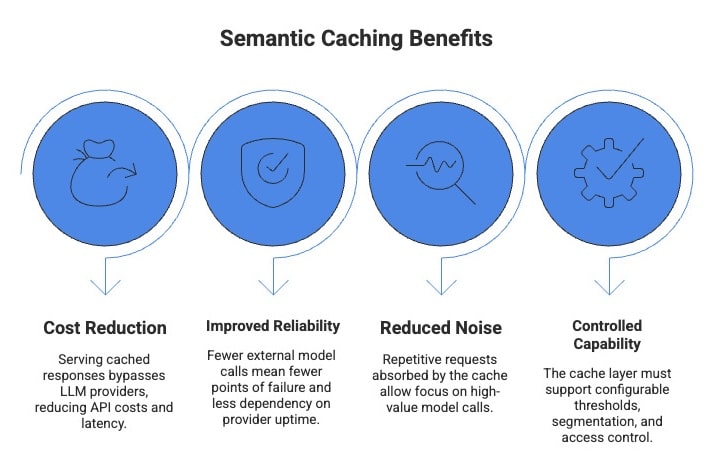
Serving a cached response allows the organization to bypass the LLM provider entirely, reducing API costs to near zero for that transaction while slashing latency from seconds to milliseconds.
By implementing these configurable caching strategies, leadership can drastically reduce AI expenditures while simultaneously improving the end-user experience through instantaneous response times.
Semantic caching introduces something extremely valuable: predictable cost avoidance. Instead of simply reducing usage, the enterprise builds an architectural mechanism that actively prevents unnecessary spend. This is a major difference between tactical savings and strategic optimization.
Semantic caching also improves reliability. Fewer external model calls mean fewer points of failure, less dependency on provider uptime, and fewer unpredictable latency spikes caused by provider-side congestion. In other words, caching is not just an optimization layer, it is a resilience layer as well.
There is also a second-order benefit: semantic caching reduces noise in observability data. When repetitive requests are absorbed by the cache, the organization can focus its monitoring efforts on high-value model calls that actually require reasoning, retrieval, and generation. This makes performance analytics more meaningful and accelerates troubleshooting cycles.However, semantic caching must be treated as a controlled enterprise capability, not as a “quick hack.” The cache layer must support configurable similarity thresholds, tenant-aware segmentation to avoid cross-department leakage, and access-control integration to ensure that cached responses respect authorization boundaries.
Proactive Token Limiting
The unpredictability of LLM billing is rooted in the black box of tokenization. Because models charge by the token, a unit that doesn’t always correlate linearly with word count, a single unoptimized RAG pipeline can inadvertently pull thousands of irrelevant document chunks into a prompt, leading to “bill shock”.
To mitigate this, executives must enforce proactive token limiting. This isn’t merely a cap on usage: it is a granular policy framework that can be applied at the global, model, team or departmental level.
For instance, a research team might be granted a high token ceiling for complex reasoning tasks, while a customer service chatbot is constrained by a strict limit per session to prevent “hallucination loops” that drain the budget.
Proactive token limiting is a direct way to enforce cost control at the infrastructure level, shifting organizations from reactive spend review to proactive prevention. It also reduces operational risk, since prompt injections, misconfigured agents, or runaway workflows can cause uncontrolled token consumption and system instability.
Token limiting can also improve output quality by preventing bloated prompts and encouraging more precise prompt engineering. Role-based policies enable different limits by identity and model class, enforced through an AI Gateway that actively controls usage before the provider is called.
Furthermore, the introduction of throttling mechanisms allows for the smoothing of usage peaks, ensuring that high-priority production environments remain stable even during periods of unexpected demand.
Coupled with rate limiting, which controls the frequency of requests to prevent spikes that degrade performance or trigger provider-side penalties, these controls transform a chaotic stream of API calls into a predictable utility. Prioritizing usage based on business priority rather than purely technical capacity ensures that mission-critical applications always have the “airtime” they need without the risk of an end-of-month financial surprise.
Centralizing Governance with the Radicalbit AI Gateway
In a fragmented ecosystem where multiple departments may be using different models, a centralized governance is the only path to scalability.
This is the specific value proposition of the Radicalbit AI Gateway. Acting as a sophisticated “air traffic controller” for all model traffic, the Gateway provides the necessary abstraction layer between the application and the model provider. It is within this architecture that the complex logic of semantic caching, request routing, and security filtering resides.
Serving as a centralized hub for AI cost optimization, Radicalbit AI Gateway empowers organizations to manage and reduce AI expenditures through a unified control plane that applies limiting and throttling policies consistently across the entire model inventory.
Unifying the control plane allows leadership to implement enterprise-wide guardrails and cost-saving policies in a single location, regardless of which underlying LLMs are utilized. This choice not only secures the data flow but also ensures that the technical debt of managing multiple API keys and billing cycles is replaced by a governed and auditable interface.
Real-Time AI Telemetry and Predictive Visibility
The final piece of the cost-management puzzle is visibility. Traditional cloud billing often arrives with a 30-day lag, which is far too slow for the high-velocity world of GenAI.
A dedicated UI dashboard, integrated directly into the AI Gateway, provides real-time telemetry into expenses at the route, group, and user levels. This observability and monitoring framework is essential for modern AI operations, allowing stakeholders to access performance and cost metrics through a real-time dashboard that offers an immediate pulse on the health and efficiency of AI deployments.
This level of granularity enables financial leaders to perform a cost-to-value analysis in real-time. If the Sales department’s GenAI usage has doubled, the dashboard can pinpoint whether that increase stems from a specific high-cost model or a surge in user volume. Crucially, connecting industry-standard observability tools ensures that AI-specific data is not siloed but integrated into the broader IT monitoring ecosystem, providing a holistic view of the enterprise’s digital footprint.
Establishing this transparency facilitates a shift toward predictive visibility, where historical trends are used to forecast future spend and set departmental budgets with confidence.
Scaling Generative AI through Strategic Observability
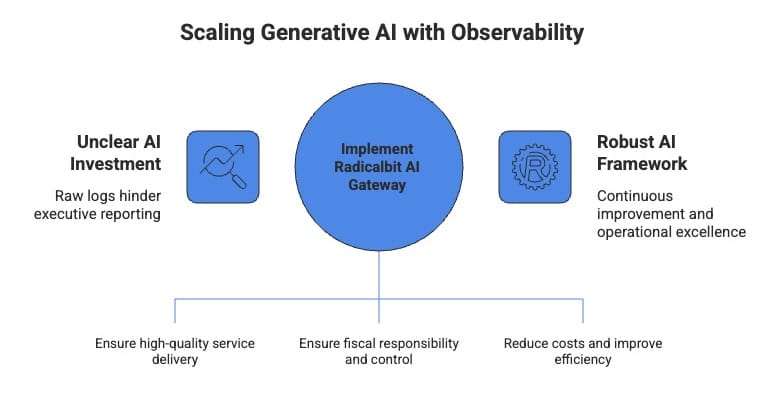
Scaling Generative AI effectively requires organizations to treat observability not just as a diagnostic tool, but as a strategic asset. Bridging the gap between raw API logs and executive-level financial reporting allows the Radicalbit AI Gateway to provide the clarity needed to justify further investment.
Consequently, technical teams can monitor latency and success rates to ensure high-quality service, while the finance department monitors consumption rates to ensure fiscal responsibility.
The synergy between cost reduction via caching and limiting, and comprehensive monitoring creates a robust framework for continuous improvement.
For example, a developer might notice through the dashboard that a specific model is underperforming on latency; they can then use the Gateway to re-route that traffic or adjust throttling parameters without disrupting the application.
This level of agility is only possible when performance and cost metrics are treated as two sides of the same coin. Leveraging these real-time insights enables businesses to iterate faster, move from pilot to production with lower risk, and maintain a high standard of operational excellence.
Establishing a Sustainable AI Model
Achieving sustainable LLM usage control requires moving beyond the fear of variable costs and toward a model of strategic surplus. When an organization masters the art of caching, limiting, and monitoring, it creates a flywheel effect: the money saved on redundant queries is reinvested into more advanced use cases, such as fine-tuning or domain-specific copilots.
Integrating the Radicalbit AI Gateway with its focus on AI cost optimization and deep observability represents more than a technical upgrade: it marks a fundamental shift in how a business interacts with machine intelligence.
This architecture provides the safety brakes that allow organizations to accelerate with confidence. Treating AI consumption with the same rigor as any other mission-critical supply chain ensures that a GenAI strategy remains as fiscally sound as it is technologically innovative.
Providing real-time visibility and configurable controls transforms the journey from “bill shock” to actionable financial intelligence into a tangible roadmap for the modern enterprise.
Are you ready to optimize your AI strategy? Transforming your AI infrastructure from an unpredictable cost center into a high-performance strategic asset begins with the right governance.
Visit the Radicalbit AI Gateway page to learn more about our specialized features or get in contact with our Team to schedule a personalized demo. Let us help you start your journey toward radical cost transparency and operational excellence today.
Frequently Asked Questions about LLM Usage Control
LLM Usage Control is the practice of governing how Large Language Models are accessed and consumed within an organization, through mechanisms like token limiting, semantic caching, throttling, and real-time monitoring, transforming AI spend from an unpredictable variable into a strategic asset.
Semantic caching uses vector embeddings to recognize queries that share the same intent even if phrased differently. When a match is found, the cached response is served without calling the LLM provider, reducing API costs to near zero for that transaction and slashing response latency.
Token limiting sets maximum consumption thresholds at the global, model, team, or user level. High-complexity research tasks may warrant larger ceilings, while customer-facing chatbots benefit from strict per-session caps to prevent runaway hallucination loops that drain the budget.
An AI Gateway provides a single control plane to enforce caching, token limits, throttling, and security policies across all LLMs and providers, eliminating the overhead of managing multiple API keys and billing cycles with one governed, auditable interface
No. When implemented correctly, it accelerates it. Savings from caching and token limiting create a flywheel effect, freeing budget to reinvest into more advanced use cases like fine-tuning or domain-specific copilots, allowing organizations to scale AI with fiscal confidence.
Key Takeaways
- LLM costs are dynamic: token density, prompt complexity, and RAG overhead make proactive governance essential to avoid unpredictable bill shock.
- Semantic caching is both a cost and resilience tool: it eliminates redundant API calls while improving reliability and observability quality.
- Token limiting shifts enterprises from reactive spend review to proactive prevention, with role-based policies tailored by team and model.
- A centralized AI Gateway is the only scalable governance model: one auditable control plane for all LLMs, replacing fragmented API and billing management.

