
In 2026, the integration of Generative AI into software engineering has progressively consolidated within engineering teams. Development pipelines consistently rely on AI agents to generate and process large blocks of enterprise code prior to the human code review phase.
This shift moves the SDLC axis away from line-by-line imperative writing toward a higher level of abstraction: vibe coding. Within this paradigm, the developer takes on the role of an orchestrator of complex agents, governing workflows through context engineering, prompt refinement, and iterative validation cycles.
Parallel to the spread of these technologies, the phenomenon of AI Sprawl is increasingly emerging, transposing the concept of Shadow IT into the era of Large Language Models. Many companies find themselves operating without granular visibility into model selection, credentials used, data privacy of segments exposed to third-party providers, and related inference costs.
The new software lifecycle introduces critical variables that directly impact regulatory compliance, code security, and token management, redefining the perimeter of responsibility for technical leaders. Consequently, engineering management requires a defined strategic choice: implement a dedicated and centralized governance layer, or absorb the economic, technical, and compliance costs resulting from an unstructured adoption.
What Changes When AI Writes Code
Assisted generation is no longer an experiment confined to a few accessory features: today, 92% of developers use AI coding tools daily, and 41% of the code produced globally is AI-generated (Secondtalent data). There is also a less-discussed but revealing figure: 63% of vibe coders are not developers in the strict sense, but rather product, design, or business profiles using AI to build functional applications and UIs.
The term vibe coding (coined by Andrej Karpathy, one of the founders of OpenAI) describes this transition from manual writing to conversational supervision: the developer no longer produces code firsthand, but evaluates its quality, verifies its consistency with company patterns, and orchestrates its integration. Therefore, value no longer resides in the volume of lines produced, but in the precision with which a team can instruct agents, validate output, and iterate.
Recent McKinsey research, conducted on approximately 300 listed companies, identified a group of top performers with results well above average: +16-30% in productivity, time-to-market, and user experience, and +31-45% in software quality. The common trait is not the tool chosen: it is the redefinition of the entire development supply chain, not just the coding phase. These companies invest in upskilling their people (for example, through practical workshops and real sprint simulations, not just theoretical courses), institutionalize result measurement (release frequency, defect rate, customer experience), align incentives and performance management with AI adoption and quality goals, and build shared knowledge graphs that give AI agents a structured context in which to operate.
However, it must be noted that even the most structured adoption strategies are not enough in the absence of a governance layer dedicated to controlling costs, security, and the traceability of interactions with models.
The ROI of Vibe Coding
Measuring the ROI of an AI coding initiative requires moving past surface-level metrics. The number of accepted suggestions or isolated completion time says little if not cross-referenced with quality, internal adoption, and economic impact.
In particular, a realistic assessment tends to consider four dimensions in parallel:
- Productivity is not measured by code writing, but by the acceleration of the entire release workflow: useful indicators include lead time from ticket to production and commit-merge-deploy cycle time.
- Quality serves to prevent speed from generating technical debt. It is worth comparing the defect density of AI-generated code with that of human code and monitoring the change failure rate.
- Adoption reminds us that impact only exists if the tool is actually used. Indicators like the acceptance rate of suggestions and developer experience surveys tell us whether the team is embracing the new workflow or merely enduring it.
- The fourth and final dimension, Economics, translates everything else into figures: license and token costs per developer per month, hours saved multiplied by hourly cost, and additional capacity made possible without new hires.
Real value emerges by periodically correlating these four pillars on enterprise dashboards shared with management, which are indispensable for measuring the actual ROI of the AI coding initiatives undertaken.
The Risks of Vibe Coding Without Governance
The aforementioned AI Sprawl phenomenon tends to emerge where the introduction of vibe coding is not yet supported by a dedicated governance layer: the use of personal API keys instead of corporate credentials, model selection left to individual developers in the absence of shared criteria, unmonitored recursive calls, and a total absence of audit trails on interactions between agents and LLMs.
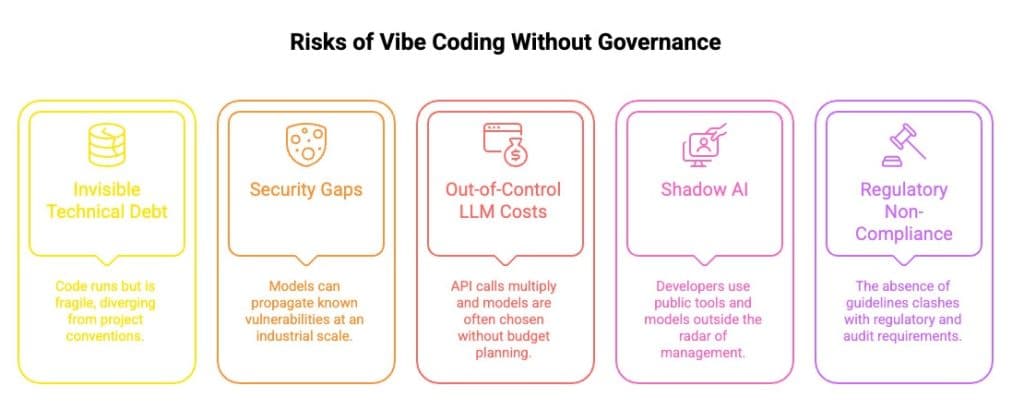
The consequences can be grouped into five macro systemic risks:
- Invisible technical debt: the code runs but is fragile, diverging from project conventions. It accumulates in modules that no longer undergo deep review. 40% of junior developers admit to deploying AI-generated code they do not fully understand: six months later, every modification takes twice as long (Secondtalent data).
- Security gaps: models can propagate known vulnerabilities at an industrial scale: exposed secrets in commits, obsolete dependencies, insecure SQL queries. If human error replicates in one repository, the systematic error of an LLM replicates across the entire company. 75% of R&D leaders report concrete concerns regarding the privacy and security of generated code (Secondtalent data).
- Out-of-control LLM costs: API calls multiply and models are often chosen on a case-by-case basis without budget planning. A single verbose agent can generate five-figure monthly costs.
- Shadow AI: to bypass internal restrictions or bottlenecks, developers use public tools and models outside the radar of management and security. Personal keys and copying-and-pasting proprietary code into prompts expose corporate IP to external providers without any control.
- Regulatory non-compliance: the absence of guidelines clashes with regulatory (AI Act, GDPR) and audit requirements. The AI Act obligations for high-risk systems take effect in August 2026, with penalties up to 7% of global turnover. In Europe, the lack of traceability becomes a blocking risk the moment the first audit arrives.
The sum of these risks makes it clear why governance has become a high priority today as adoption itself. In this context, limiting AI use in development is neither a viable path nor desirable from a competitive standpoint: the differentiator is the presence or absence of an infrastructure capable of making it controllable.
Governing AI with Radicalbit AI Gateway
At the enterprise level, the answer to AI Sprawl is not a patchwork of policies for every tool: it is a mediation layer between agents and models, much like what the corporate proxy was for web traffic twenty years ago.
The AI Gateway acts as a single selection layer: it provides agents with the credentials needed to access models and applies all corporate policies regarding budget, security, and approved models during transit. The complexity of governance is thus removed from the individual developer’s perimeter and brought back to a single point of responsibility managed by the company admin.
The benefits span several dimensions:
- Cost Control: Real-time dashboards on LLM spend, response caching, and rate/token limiting mechanisms allow for real-time visibility into spending per repository and per developer, catching “rogue agents” before the bill explodes.
- Security: Automatic anonymization of sensitive data in transit, enabled by PII detection engines like Microsoft Presidio, with filters applied to prompts and outputs to protect the corporate perimeter without developer intervention.
- Compliance: Full audit trails and structured logging, with native coverage of AI Act and GDPR requirements.
- Reliability: Multi-provider automatic fallback, ensuring business continuity even when a single model is temporarily unavailable.
- Governance: A single access point and centralized policies that put an end to Shadow AI within the company.
- Scalability: The same framework can be used from a single team up to the entire enterprise perimeter without rewriting code, transforming standardization into an accelerator rather than a bottleneck.
The value of this approach is not to introduce another layer of bureaucratic control, but to provide the company with the tools to adopt vibe coding sustainably: the necessary visibility into costs, oversight of sensitive data, and the documentation required by audit processes, without having to interfere with individual developer workflows.
Today, the decision-making perimeter for engineering companies is no longer the choice between adopting or not adopting AI in development, but defining the governance model within which that adoption takes place.
To learn more about the architecture, integration methods, and use cases of Radicalbit AI Gateway, visit the dedicated page.

