

Shadow AI is the unsanctioned use of Generative AI tools within an organization. It occurs when employees input sensitive company data into external AI systems without IT oversight or security protocols, often to bypass internal friction. Over the past two years, Generative AI tools have evolved from experimental novelties into essential everyday productivity infrastructure. Developers leverage them to write code at unprecedented speeds, analysts summarize complex datasets in seconds, and marketing teams draft compelling content in minutes. Technically, this happens because the “friction to value” of these tools is near zero: an employee only needs a personal browser and a login to bypass all corporate security firewalls.
However, these seemingly innocuous actions introduce a serious challenge, as sensitive information leaves the organization’s controlled environment to be processed by external AI services with unknown data retention policies.
Considering that the problem is rarely malicious, stemming instead from employees simply trying to move faster, Shadow AI is notoriously difficult to address. From a technical perspective, the lack of a “chokepoint” or a proxy layer means that IT departments have zero visibility into the payload of the HTTPS requests being sent to OpenAI, Anthropic, or Google.
Organizations that attempt to block access often discover that usage simply migrates to personal devices, alternative services, or unmanaged APIs. In practice, banning AI rarely eliminates its use; it merely removes visibility, creating a new category of enterprise risk where AI adoption outpaces the speed of corporate governance.
Why Shadow AI Is a Security and Compliance Risk
When employees utilize public AI tools directly, several interconnected risks emerge simultaneously, starting with data exposure.
Many Generative AI platforms process prompts externally, meaning that if an employee pastes internal documentation, source code, or customer data into a chatbot, that information may be stored, logged, or used for model improvement depending on the provider’s policies.
To better understand the impact, here is a comparison between unmanaged AI use and a secure adoption strategy through an enterprise AI Gateway:
| Feature | Shadow AI (Unmanaged) | Enterprise AI Gateway (Managed) |
| Data Visibility | Zero visibility into shared payloads | Centralized logging and audit trails |
| Privacy Protection | High risk of PII leaks (GDPR) | Automated PII masking and scrubbing |
| Cost Management | Impossible to track fragmented spend | Token monitoring and budget per team |
| Governance | No control over safety policies | Granular policy enforcement (e.g., Geo-fencing) |
Even when vendors claim they do not train on user data, organizations typically lack the contractual guarantees, audit logs, and governance controls required by stringent internal compliance standards. Furthermore, the lack of automated PII scrubbing means that even a simple customer support query could leak GDPR-protected data into a third-party model’s training set.
Here’s a few real-world examples:
- A developer troubleshooting an error pastes a section of proprietary code containing hardcoded credentials or internal IP addresses into a public chatbot.
- A legal team member summarizes a confidential contract containing M&A details using an LLM assistant.
- A data analyst uploads a dataset containing customer attributes including plain-text emails to generate insights.
While none of these actions are malicious, they each involve sensitive data leaving controlled systems.
Beyond data leakage, a secondary problem emerges: a total lack of traceability. When employees interact directly with AI services, organizations lose the ability to track fundamental metrics, such as what data was shared, who accessed which models, and which prompts generated which outputs. Without this visibility, organizations face a serious auditability gap, which is especially critical in regulated industries where compliance frameworks require strict control over data flows and third-party services.
An AI Gateway – as will be discussed in greater detail later in this article – addresses this by acting as a reverse proxy, intercepting every API call to log metadata, such as timestamp, user ID, model used, and token count without compromising the developer’s speed.

The Hidden Cost of Fragmented AI Access
In many organizations, AI adoption happens organically and inconsistently. One team might experiment with OpenAI APIs while another integrates Anthropic models, all while developers create scripts with hardcoded API keys. Within months, what began as experimentation transforms into a patchwork of unmanaged integrations, introducing several operational problems.
- Security Vulnerabilities: API keys become scattered across systems, embedded in scripts, notebooks, or internal tools. These credentials are sometimes shared across teams via messaging platforms, making it increasingly difficult to track where these secrets exist or how they are used.
- Increased Risk and Maintenance: if an API key is leaked or misused, organizations face unexpected costs, data access issues, or service disruptions. Without centralization, rotating a single master key requires manual updates across dozens of microservices instead of a single point of control.
- Opaque Cost Management: Without centralized tracking, it is nearly impossible to quantify how much is being spent on generative AI usage across teams, leading to duplicated workloads or the unnecessary use of expensive models for simple tasks.
- Inconsistent Governance: Different teams may use clashing model versions or safety policies, resulting in unpredictable outcomes and AI capabilities that are powerful but completely unmanaged.
This shift in reality means the question is no longer whether employees should use AI, but rather how organizations can provide these capabilities safely, transparently, and at scale.
Why Banning AI Tools Doesn’t Work
Some organizations respond to Shadow AI by attempting to block access to public AI platforms entirely, but while this approach may appear sensible at first glance, it rarely works in practice. Because AI tools deliver immediate productivity gains, employees quickly discover alternative access points, effectively increasing Shadow AI rather than reducing it.
The pattern mirrors the evolution of cloud computing a decade ago. When organizations tried to block cloud services outright, teams began using them independently, leading to the emergence of “Shadow IT.” Eventually, the solution was not prohibition but rather centralization and enablement. By introducing secure cloud platforms and infrastructure governance frameworks, organizations allowed teams to innovate safely.
The same evolution is now happening with Generative AI: instead of blocking access, organizations must provide sanctioned AI infrastructure that satisfies three fundamental requirements:
- Robust security and data protection, including PII masking and prompt injection prevention;
- Operational visibility and auditability (centralized logging of all LLM interactions);
- Flexibility to support diverse models and use cases, avoiding vendor lock-in by decoupling apps from specific LLM providers.
The architectural pattern emerging to solve this challenge is the AI Gateway.
The Role of an AI Gateway
An AI Gateway acts as a centralized access layer between internal applications and external AI models. Rather than allowing every team to connect directly to multiple AI providers, organizations route all AI interactions through a controlled gateway, an architecture that provides several immediate advantages.
To bridge the gap between unsanctioned usage and an enterprise-grade AI strategy, organizations could adopt a framework that includes the following major steps:
- Audit and Discovery: Identify which AI tools are currently being used by employees;
- Centralization: Implement an AI Gateway as the single entry point for all API requests;
- Policy Enforcement: Configure filters for sensitive data (PII) and set budget limits per department;
- Continuous Monitoring: Analyze logs to optimize costs, performance, and ensure ongoing compliance.
The implementation of an AI Gateway provides several key advantages, including:
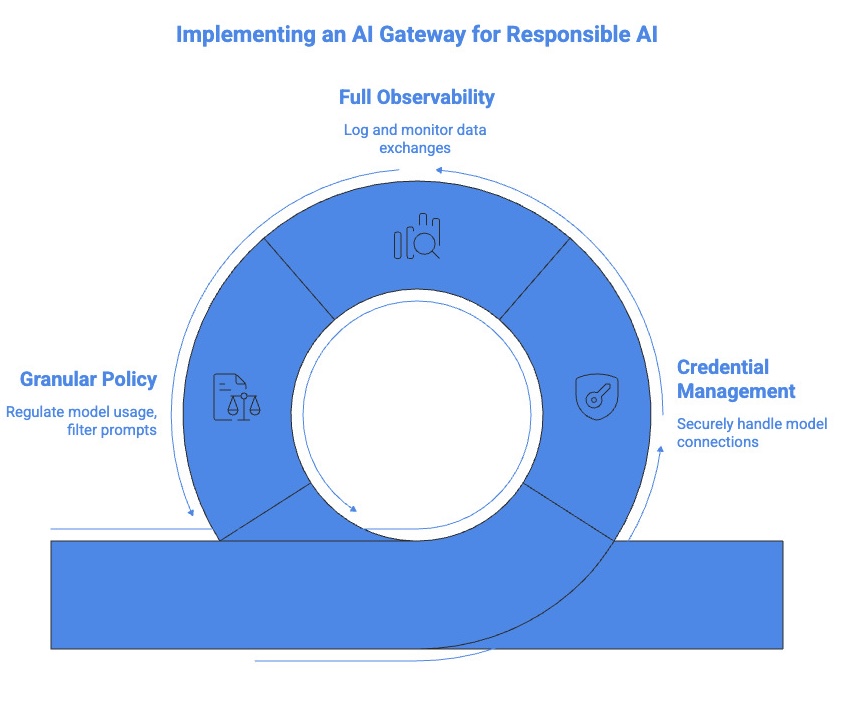
- Credential Management: An AI Gateway eliminates scattered API keys by managing provider access centrally. Teams authenticate through the Gateway using standard protocols, which securely handles the underlying model connections, thereby removing the problem of hardcoded secrets while simplifying credential management. This decoupling means that if a provider changes their API version or a specific model is deprecated, the change only needs to be managed at the gateway level, leaving the internal application code untouched.
- Observability and Reporting: An AI Gateway introduces complete observability, allowing every prompt, response, and data exchange to be logged and monitored. This transforms AI adoption into a measurable operational capability, enabling leadership to see which teams are using which models and detect unusual patterns of activity.
- Granular Policy and Automated Safety: An AI Gateway enables organizations to regulate which models process sensitive data, filter prompts containing confidential information, and enforce rate limits. For instance, a company could set a policy that “No PII can be sent to models hosted outside the EU”. To automate these safety standards, the Gateway incorporates specialized guardrails like the Toxicity Detection Judge, which functions as a dedicated moderation expert, performing real-time linguistic analysis to identify and intercept inappropriate content.
By ensuring that innovation does not come at the expense of security, these controls facilitate a vital cultural shift toward responsible AI usage.
Enabling AI Adoption Without Losing Control
When organizations provide a secure and centralized AI infrastructure, employees no longer need to rely on unsanctioned tools. Instead of working around governance policies, teams gain access to approved, monitored AI capabilities that integrate directly into their workflows, shifting the conversation from restriction to enablement.
The AI Gateway can even provide Model Fallback or Load Balancing: if OpenAI is experiencing high latency, the Gateway can automatically route the request to a secondary provider like Azure OpenAI, ensuring zero downtime for business processes.
The difference is that all interactions happen within the organization’s controlled infrastructure, which not only reduces security risks but also improves operational efficiency. When AI usage is centralized, organizations can optimize model selection, manage costs, and evaluate performance across different providers, creating a mature AI ecosystem where experimentation thrives alongside built-in governance.
From Shadow AI to Secure AI Infrastructure
Shadow AI is not a temporary trend, but a natural consequence of powerful technology becoming easily accessible. Employees will continue using AI tools because they deliver real productivity improvements; therefore, the goal should not be to stop AI adoption, but to guide it through secure and scalable infrastructure.
Centralizing Generative AI access through an enterprise-ready solution like the Radicalbit AI Gateway allows organizations to address the core risks of Shadow AI while preserving the benefits that made these tools attractive in the first place. By providing a unified API (one entry point for multiple LLMs), the solution allows organizations to switch between providers with a single configuration change, ensuring complete visibility and control over usage.
Ultimately, Generative AI will become a foundational component of enterprise workflows. The organizations that succeed will not be those that resist its adoption, but those that build the right infrastructure to manage it.
If your teams are already using AI tools today, the real question is no longer whether Shadow AI exists, but whether you possess the infrastructure to control it. Your data, indeed, deserves enterprise-grade protection without sacrificing the speed of innovation. Gain full visibility into your AI ecosystem by visiting the Radicalbit AI Gateway page or get in contact with our team. Transition from fragmented AI to a unified, transparent, and secure operational standard today.
Frequently Asked Questions about Shadow AI
The main risk is data leakage: employees may unintentionally share trade sensitive information or personal data with public models that use them for training.
No. Total bans often drive usage to personal devices or less secure alternatives, removing all visibility for the IT team and actually increasing corporate risk.
It provides employees with a secure, sanctioned alternative. It acts as an intermediary that masks sensitive data, manages API keys securely, and tracks every interaction for auditing.
On the contrary, it simplifies the integration of multiple models through a single interface, removing the need to manually manage various credentials and configurations.
A Gateway is a key enabler for compliance, provided it is configured for PII Masking to redact sensitive data before it reaches AI providers. However, full compliance also requires ensuring a legal basis for processing, verifying data residency (storage location), and having a Data Processing Agreement (DPA) in place with the model providers.
Key Takeaways
- Shadow AI is inevitable, not malicious: employees adopt unsanctioned AI tools simply to move faster, making prohibition ineffective and even counterproductive.
- Banning AI increases risk: blocking access drives usage to personal devices and unmanaged services, eliminating the last traces of IT visibility.
- Data leakage is the core threat: from hardcoded credentials to GDPR-protected customer data, even routine AI use can expose sensitive information to external systems with unknown retention policies. An AI Gateway is the architectural answer: centralizing all LLM traffic through a single controlled layer restores visibility, enforces compliance policies, and simplifies credential management without slowing teams down.
- The goal is enablement, not restriction: organizations that win with AI will be those that build secure, scalable infrastructure allowing teams to innovate within guardrails, not around them.

